电影天堂
China steps up emergency response as Typhoon Dolphin approaches coast_我的网站

一 |
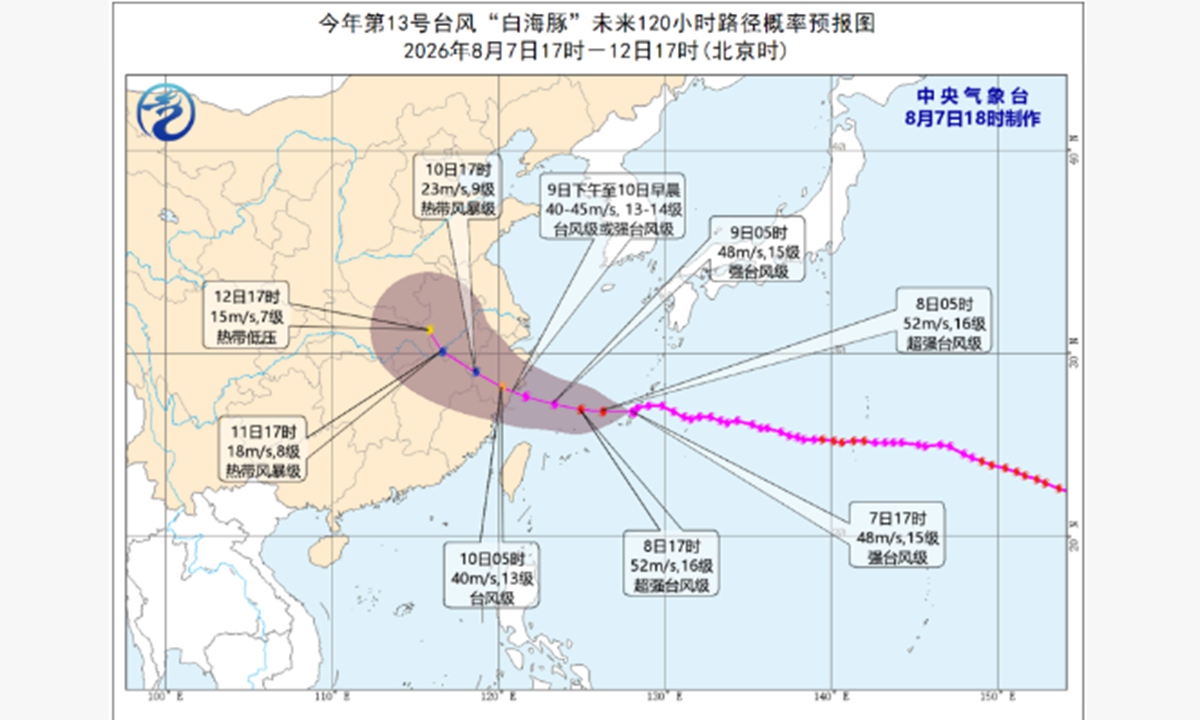
A 120-hour forecast track probability map for Typhoon Dolphin from 5 pm on August 7 to 5 pm on August 12. Photo: National Meteorological CenterMultiple national departments and local authorities have activated emergency response measures as Typhoon Dolphin, the 13th typhoon of 2026, approaches China's eastern coast, in an effort to safeguard people's lives and property.
China's National Meteorological Center (NMC) continued to issue a yellow alert for Typhoon Dolphin at 6 pm on Friday. As of 5 pm, the center of the typhoon was about 730 kilometers east of Wenzhou of East China's Zhejiang Province. It was packing maximum sustained winds of 48 meters per second (Level 15) near its center, with a minimum central pressure of 940 hectopascals. According to the NMC's tropical cyclone classification, Dolphin is classified as a severe typhoon.
Dolphin is expected to move westward at a speed of about 15 kilometers per hour while continuing to intensify. It is forecast to enter the East China Sea on Friday night and make landfall along the coast from Zhejiang Province to northern Fujian Province between Sunday afternoon and Monday morning. After landfall, it is expected to move west-northwestward and gradually weaken, according to the NMC's forecast.
At 6 pm on Friday night, China's Ministry of Water Resources launched a Level IV emergency flood response for Shanghai and the provinces of Jiangsu, Zhejiang, Anhui, Fujian and Jiangxi. The Ministry of Natural Resources activated a Level III marine disaster emergency response for Zhejiang, a level IV response for Shanghai, Jiangsu, and Fujian, and convened a meeting on Friday to coordinate marine and geological disaster prevention and response efforts for Typhoon Dolphin, making comprehensive arrangements for disaster preparedness, the Xinhua News Agency reported on Friday, citing the two ministries.
Coastal provinces have been stepping up preparations as Typhoon Dolphin approaches. According to Xinhua, authorities in Zhejiang Province upgraded emergency responses for Typhoon Dolphin from Level IV to Level III at noon on Friday. Fujian Province also upgraded its emergency response to Level III, according to provincial authorities.
Typhoon Dolphin is expected to bring strong winds and heavy rainfall to parts of eastern China. According to Xinhua, from Friday to Tuesday, Zhejiang, Fujian, Jiangxi, Jiangsu, Shanghai and Anhui are forecast to receive heavy to torrential rain, raising the risk of flooding in major river basins and smaller rivers. Fujian authorities have also suspended some ferry and passenger transport services and closed tourist attractions in parts of the province as a precaution.
Xu Yinglong, chief forecaster at the NMC, said Typhoon Dolphin is currently being influenced by a combination of the subtropical high, the westerly trough-ridge system and multiple tropical systems, leaving some uncertainty over its track after landfall. Tropical disturbances over the Beibu Gulf and the western Pacific could also affect Dolphin's development and path, according to the official WeChat account of the China Meteorological Administration.
As Dolphin approaches China's eastern coast, impacts from wind and rain are expected to intensify. Xu said the typhoon could bring stronger localized winds than Typhoon Bavi, the ninth typhoon of this year, while producing heavier and more widespread rainfall, with some areas likely to experience extreme precipitation.
From Friday to Saturday afternoon, waves of 7 to 13 meters are forecast in the East China Sea, while waves of 4 to 6.5 meters are expected in the coastal waters off Zhejiang. The coastal waters off Shanghai and northern Fujian are forecast to see waves of 3 to 4.5 meters. Meanwhile, storm surges of 50 to 120 centimeters are expected along the coast from the Yangtze River estuary to Fuzhou in Fujian Province from Friday afternoon to Saturday afternoon, the Global Times learned from the National Marine Environmental Forecasting Center.
Global Times
。

二 | 央广网北京1月11日消息(记者王迟)1月10日,山西临汾市尧都区发生4.1级地震。此次地震属于什么类型?与近期发生的青海玛多县5.5级地震、西藏日喀则6.8级地震是否有关联?记者就此采访有关专家。近期几起地震是否有关联?四川大学自然灾害预警研究中心主任、中国地震局地震预警技术研究成都中心主任王暾表示,临汾地震与前几天青海、西藏等地发生的地震,从目前的观测数据来看,并未发现关联性。他指出,山西、青海以及西藏的地震都发生在地震活跃区域,因此这些地震可以视为正常地质能量释放的表现。

三 | 山西位于汾渭地震带上,历史上也曾多次发生地震。从地震关联性的角度来看,一个区级的地震应力释放通常只对其周边100公里范围内的区域产生影响,而像临汾与青海、西藏等地相隔数千公里,因此它们的地震之间并无直接关系。针对公众关心的“地球活跃度是否变高”的问题,王暾表示,目前的数据并不足以支持这一结论。地震是一种复杂的自然现象,其发生与多种因素有关。公众应保持理性态度,关注官方发布的地震信息,并采取必要的防震减灾措施。北方民族大学副教授、地质高级工程师陈美君指出,其实地震对于地球来说是件日常的事,地球内部蕴含巨大能量,始终都在寻找突破点输出这部分能量。“我们知道的板块边界、断层就是最薄弱的位置,因此地震带、火山带就分布在板块边界和各个断裂带附近。地球上的地震一直都在发生,只是大部分都在三级以下,我们一般感觉不到。”另外,她表示,现在地震信息传播比以前要广泛得多,也会给人地震很频繁的感觉。

四 | 地震发生后如何科学避险?更多精彩资讯请在应用市场下载“央广网”客户端。欢迎提供新闻线索,24小时报料热线400-800-0088;消费者也可通过央广网“啄木鸟消费者投诉平台”线上投诉。版权声明:本文章版权归属央广网所有,未经授权不得转载。转载请联系:[email protected],不尊重原创的行为我们将追究责任。
Current article:http://cofzf.wenwancaomohenenqiongpangshun.bond/b8bgz/20260826/264413.html
Published on:12:01:18
 微信
微信 移动端
移动端